

MVP Development Strategies That Actually Scale
April 3, 2026
You have a brilliant idea. You want to build it fast, get it in front of users, learn quickly, and grow. That is exactly what MVP app development promises — and for good reason.
But here is the problem most founders and product teams discover too late: the MVP they built to move fast becomes the very thing that stops them from scaling.
Corners cut during the minimum viable product development phase — a shortcut here, a workaround there — often turn into technical debt that takes months and costs a lot to fix. Features that should take a sprint end up taking a quarter. Investors get nervous. Users churn. Momentum slows down.
This guide exists because that story does not have to be yours.
Whether you are a startup racing to product-market fit or an enterprise testing a new idea, the MVP development strategy you choose today will directly impact your ability to scale tomorrow.
According to CB Insights, 35% of startups fail due to a lack of market need, while 38% run out of cash. A well-planned MVP strategy helps validate your idea early and reduce both risks.
Let’s break down how to build an MVP that sets you up for long-term success.
What is an MVP — Really?
The term “minimum viable product” gets thrown around a lot, and often incorrectly—especially in discussions around prototype vs MVP. An MVP is not a prototype. It is not a buggy beta with a disclaimer. It is not half a product.
A true MVP is the smallest version of your product that delivers real value to a real set of users, captures meaningful feedback, and validates your core business hypothesis.
That last part matters enormously. An MVP is a learning tool, not just a launch tool. The goal of minimum viable product development is not simply to ship something — it is to answer specific, critical questions about your product and market as quickly and cheaply as possible.
Key Distinction: Speed is valuable in MVP development, but only when paired with intentional architecture. Rushing to launch without a scalable foundation is not agility — it is risk.
The MVP approach to product development means you deliberately choose what to build first based on what you need to learn. That requires clarity about your riskiest assumptions before you write a single line of code.
Why Most MVPs Fail to Scale (And How to Avoid Their Mistakes)
Before we get into what works, it is worth understanding what goes wrong. The graveyard of failed products is full of MVPs that launched successfully but could not survive their own growth.
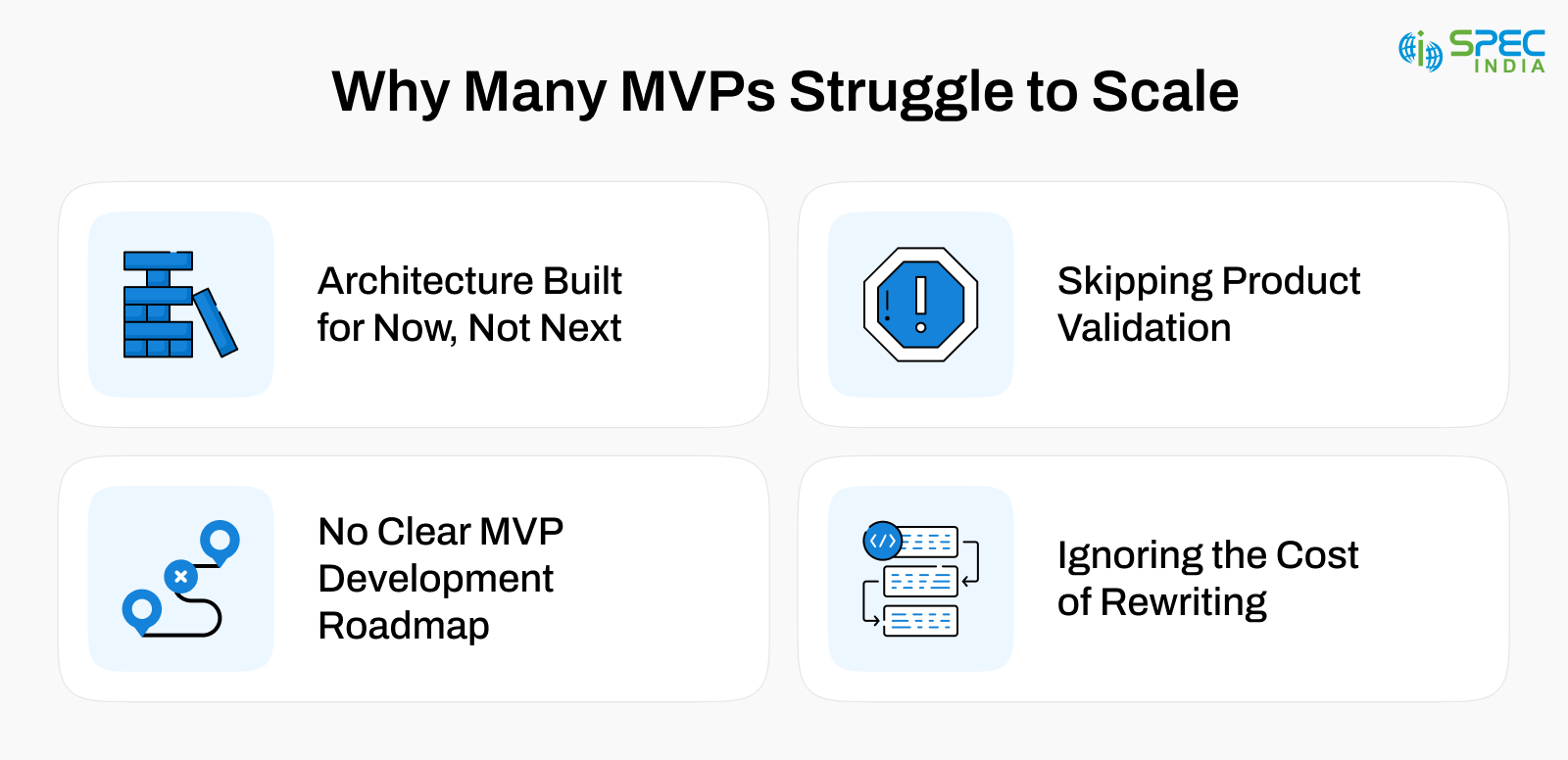
1. Architecture Built for Now, Not Next
The most common technical mistake in MVP app development is designing the architecture around the current use case rather than the eventual one. When you hard-code a single-tenant assumption into a product that will need to serve thousands of companies or build on a monolithic structure that cannot be decomposed later, you are not cutting corners — you are building a ceiling.
Scalable MVP development does not mean over-engineering from day one. It means making deliberate architectural choices that leave doors open rather than closing them.
2. Skipping Product Validation
Some teams treat the MVP as a solution in search of a problem. They build what they think users want rather than what they have confirmed users need. Product validation — the process of testing assumptions with real users before and during development — should be woven into every sprint, not treated as a pre-launch checkbox.
Harvard Business School professor Clayton Christensen’s research suggests that 95% of new products fail. Systematic product validation dramatically improves those odds by ensuring you are building something people want.
3. No Clear MVP Development Roadmap
Teams that launch an MVP without a roadmap are not being agile — they are being reactive. A clear MVP development roadmap defines not just what you are building now but also which signals would cause you to build next. It creates alignment between engineering, product, and business so that scaling decisions are made proactively rather than in crisis mode.
4. Ignoring the Cost of Rewriting
Many founders underestimate how expensive it is to rebuild a product from scratch. When an MVP is so poorly architected that scaling requires a full rewrite, you are not just losing development time — you are losing the compound value of iteration, user feedback, and market momentum. That cost can be existential for an early-stage company.
Core MVP Development Strategies That Actually Scale
Here are the strategies that separate MVPs that grow from those that collapse under their own weight.
Strategy 1: Start with a Hypothesis, not a Feature List
Every great MVP begins not with a product specification but with a clearly articulated hypothesis. What do you believe is true about your users, their problems, and how your solution addresses those problems? What evidence would confirm or refute that belief?
This mindset shift changes everything about how you build. Instead of asking “What should we build?” you are asking “What is the fastest way to test whether this is worth building?” Sometimes that means a landing page. Sometimes it means a Wizard of Oz prototype. Sometimes it means an MVP mobile app. The method depends on the hypothesis.
Strategy 2: Design for Modularity from Day One
Good MVP architecture does not mean building everything — it means building in a way that makes adding everything possible. Modular architecture, where components can be developed, deployed, and scaled independently, gives you the flexibility to grow without friction.
This is especially important for MVP mobile app development, where platform requirements, device diversity, and performance constraints compound quickly as user volume grows. A modular codebase means a new engineer can contribute to the payments module without touching the notifications system. It means a performance bottleneck in one service can be addressed without redeploying the entire application.
Pro Tip: Even if you are not using microservices on day one, structure your code as if you might. Clean separation of concerns in a monolith is far easier to break apart later than a tightly coupled mess.
Strategy 3: Prioritize Core Infrastructure Early
There is a paradox at the heart of MVP development: the things that seem least important early on — logging, monitoring, authentication, data architecture — are often the most critical at scale. A product that cannot be debugged in production cannot be improved. A data model that was not thought through from the beginning becomes a migration nightmare at scale.
Investing in core infrastructure early is not scope creep. It is the foundation on which everything else rests.
Strategy 4: Build a Feedback Loop into the Product
Scalable MVPs are not built once — they evolve continuously. The most successful MVP development strategies treat user feedback not as a post-launch activity but as a core product feature. Instrumentation, analytics, and in-product feedback mechanisms should be part of your MVP, not afterthoughts.
This applies to both MVP development for startups and enterprise MVP development. Organizations that build systematic feedback collection into their products from the beginning learn faster, iterate smarter, and build more durable competitive advantages.
Strategy 5: Define Your Tech Debt Policy Explicitly
Every MVP accumulates technical debt. The question is not whether you will incur it but whether you will manage it intentionally. Teams that explicitly define what debt they are willing to take on — and for how long — are far better positioned than teams that simply move fast and hope for the best.
A healthy tech debt policy might say: “We will accept short-term shortcuts in the UI layer, but never in data storage or authentication. We will commit 20% of each sprint to debt repayment once we hit 1,000 daily active users.” That kind of explicit policy prevents the slow accumulation of decisions that, individually small, collectively become paralyzing.
MVP Development for Startups: Speed with Intention
For startups, the pressure to move fast is real. Capital is finite, windows of opportunity are narrow, and the market does not wait. But speed without intention is not velocity — it is chaos.
The most effective MVP development for startups balances the urgency of the market with the discipline of good engineering. Here is what that looks like in practice.
-
Validate Before You Build
Before committing engineering resources to an MVP, push your product validation as far as possible through non-technical means. Customer interviews, landing pages, mockup tests, and concierge services can answer many of your most important questions without a single line of production code.
Many successful companies did this. Dropbox famously validated the idea with a demo video before building the product. Zappos founder Nick Swinmurn manually fulfilled shoe orders to test demand before building a platform. The lesson: your MVP strategy should begin with the lightest test possible.
-
Choose Your Tech Stack for Longevity, Not Just Familiarity
Many startup MVPs are built in whatever language the founding engineer knows best. That is understandable — but it is worth at least interrogating whether that choice scales with your ambitions. Some stacks are better suited for rapid iteration. Others are better for high-performance, high-volume applications. Making an informed choice early can save enormous pain later.
-
Think About the Team That Will Maintain This
The engineers who build your MVP are rarely the only ones who will ever work on it. Design your codebase for the team you are building, not just the one you have today. Documentation, consistent patterns, and readable code are not bureaucratic overhead — they are the difference between a product that accelerates with each new hire and one that slows down.
Startups that invest in developer experience and codebase quality report 60% faster feature delivery cycles, according to DORA research metrics. The investment pays dividends faster than most founders expect.
The MVP Development Roadmap: Thinking Beyond Launch
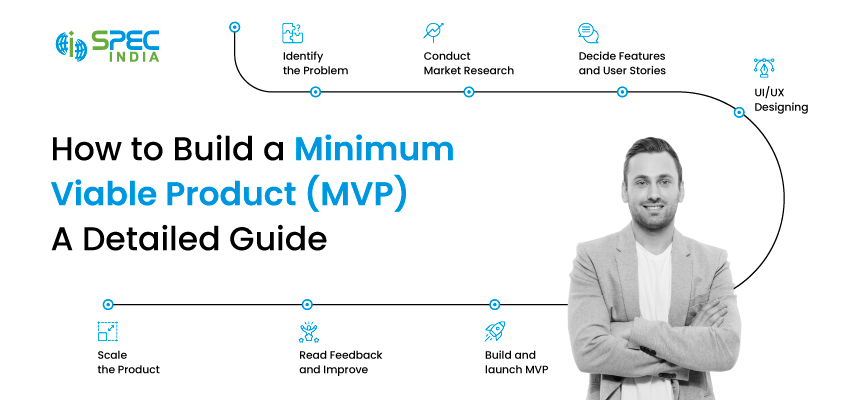
A common mistake is treating the MVP as the destination. It is not. The MVP is the beginning of a journey, and a well-designed MVP development roadmap helps you navigate that journey intentionally.
Your roadmap should answer three questions for each phase of development:
- What are we building, and why?
- What do we need to learn, and how will we learn it?
- What signals will tell us to proceed, pivot, or stop?
The third question is often skipped, but it is the most important. Without clear criteria for what constitutes success or failure, teams continue to build in directions that are not working because no one has given themselves permission to change course.
-
Phase 1: Discovery and Validation
Before a single line of production code is written, spend time deeply understanding your user, their problem, and the existing solutions they have tried. Map the assumptions your product is built on. Rank them by risk. Design your MVP to test the riskiest ones first.
-
Phase 2: Build and Measure
Build the minimum set of features that allows you to test your core hypothesis with real users. Instrument everything. Ship quickly. Measure relentlessly. The goal is not a perfect product — it is validated learning.
-
Phase 3: Learn and Iterate
Use what you learn to inform the next iteration. Sometimes this means doubling down on what is working. Sometimes it means removing features that are not being used. Occasionally, it means pivoting the core direction entirely. The willingness to be ruthlessly honest about what the data is telling you is what separates great product teams from ones that are simply busy.
-
Phase 4: Scale
Once you have validated your core hypothesis and found meaningful product-market fit, the focus shifts from learning to scaling. This is where the architectural decisions you made early either serve you or haunt you. A scalable MVP — one built with modularity, good infrastructure, and clean abstractions — can grow gracefully. One that was not will require a painful reckoning.
MVP Mobile App Development: Special Considerations
Web apps and mobile apps are not the same animal. When you go mobile, you inherit a whole new class of problems — devices that behave differently, app stores that move on their own schedule, users who never update, and connectivity that drops at the worst moments. None of these are dealbreakers, but all of them need to be factored in from the start.
-
Choose Your Platform Strategy Carefully
The platform question comes up early, and it deserves a real answer rather than a default one. Should you build iOS first? Android? Both? Native or cross-platform? Honestly, it depends on your users, your budget, and what your product needs to do. If your target audience skews professional and US-based, iOS probably comes first. If you are going after a broader global market, Android makes more sense. If your app needs deep hardware access or bleeding-edge performance, native speakers are worth the extra cost.
React Native and Flutter have come a long way — for most MVP mobile apps, they are perfectly capable and will save you significant time and money. Just do not pick them up because they seem easier. Pick them because they genuinely fit what you are building.
-
Design for the App Store Timeline
Here is something that catches first-time mobile builders off guard every single time: the App Store does not care about your launch date. Apple’s review process runs on its own timeline, and if your submission gets rejected — for a privacy policy issue, a missing permission string, an unclear screenshot — you are back in the queue. That can mean days or weeks of delay. Build that buffer into your schedule before you need it, not after.
-
Thinking About Updates and Versioning
Web apps are easy to update — you deploy, and everyone gets the new version. Mobile is messier. Some users will never tap on that update button. Six months after launch, you could have meaningful chunks of your user base on version 1.0 while you are shipping version 3.0. Your API must handle that gracefully, or you’ll break things for real people. Design for version coexistence from the beginning is not an edge case; it is the reality.
How to Choose the Right MVP App Development Services
Not every team has the bandwidth or the depth to build an MVP well on their own — and that is fine. Bringing an external MVP app development services partner can get you to market faster and give you access to people who have been through this before. But the partner you choose matters enormously. The wrong one will give you a beautiful product that falls apart the moment you try to grow it.
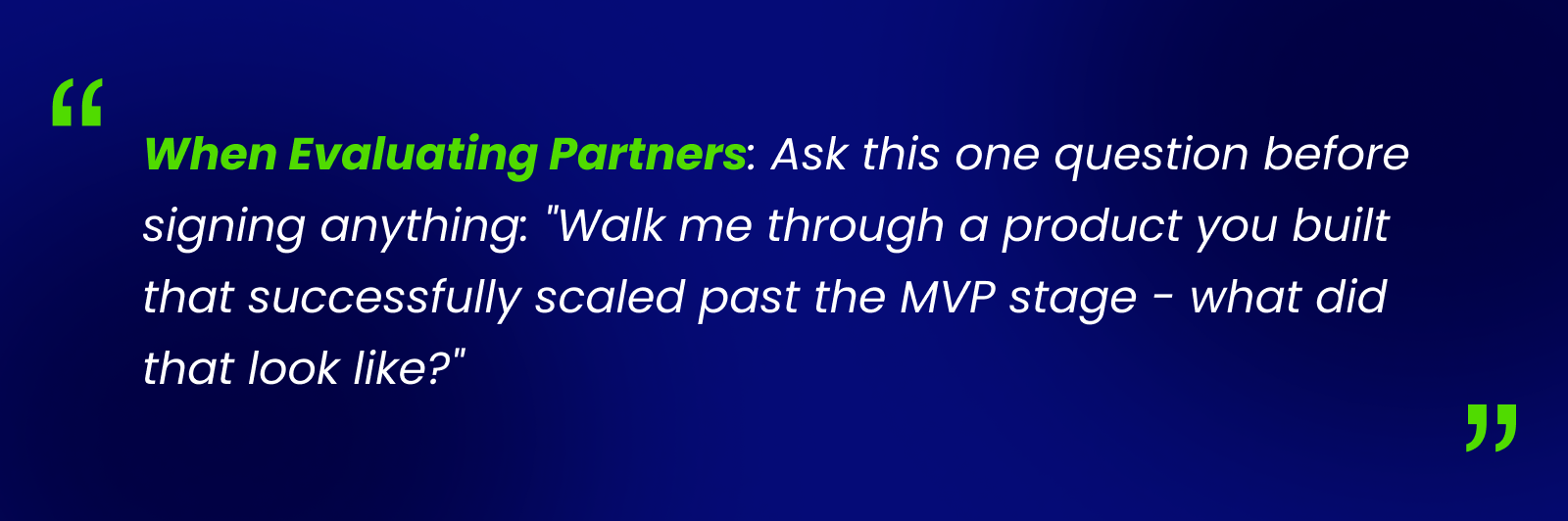
Do not get dazzled by portfolios and case studies. Those tell you what a partner has built — they do not tell you whether those products scaled. Dig into their process. How do they approach product validation before writing code? What does their architecture look like six months post-launch, as user numbers start to climb? The best product development services firms think well past the launch date.
If you are building SaaS specifically, make sure your partner knows SaaS. Multi-tenancy, subscription billing, data isolation, and role-based access — these are not things you want to figure out on the fly. A generalist shop can get you a working product; a team with real SaaS app development services experience will build you one that does not crack under the weight of its own growth.
Conclusion: Build to Learn, Design to Scale
The fastest MVP is not always the best one. Neither is the most polished one. The one that wins is the one that answers your riskiest questions quickly enough to matter — and does not burn down the foundation in the process.
Everything covered in this guide — validating before building, designing modularly, managing tech debt on purpose, building feedback into the product — none of it is particularly new or complicated. What makes it hard is the discipline to do it when you are under pressure to ship. That discipline is what separates MVPs that grow into real products from those that quietly get replaced.
MVP app development is just disciplined learning. Build the smallest thing that teaches you the most important thing. Do that repeatedly, and you will end up with something worth scaling.
If you are ready to build something that holds up — reach out. Our product development services, SaaS app development services, and MVP app development services are built around one idea: move fast without making a mess you cannot clean up.
Frequently Asked Questions
Honestly, the hardest part is knowing what not to build. Scope creep kills more MVPs than bad code does. Beyond that — validating your idea before the money runs out, picking a tech stack you can live with long-term, and finding the right people.
Bad early architecture is the most common culprit — decisions that made sense at 100 users become walls at 10,000. Technical debt compounds fast when no one is managing it. And sometimes the product just never had real fit, and early traction masked that until it did not.
Be honest about which shortcuts are reversible and which ones are not. Hard coding a config? Fine, fix it later. Designing a bad data model? You will be paying for that for years. Move fast where it is safe to move fast, and slow down where it matters.
Mostly organizational, not technical. Getting buy-in, navigating procurement, dealing with legacy systems that were never meant to talk to new software — that is where enterprise MVPs stall. The teams that succeed bring IT and compliance into the room early rather than springing things on them at the end.
Do not let your legacy systems bleed into your new product. Build a clean separation — APIs, middleware, adapters — so your MVP does not inherit decades of technical complexity. Connect what you need to connect, keep it thin, and expand as you go.
Rushing the data model, skipping tests because "we will add them later," ignoring security until it becomes a problem, and building everything so tangled together that changing one thing breaks three others. Any one of these is survivable. All of them together? That is a rewrite.
Think about the past launch from day one. Build modular, model your data carefully, and instrument everything so you know what is happening in production. And write down the decisions you are making — your future self, and whoever joins the team next, will thank you.

SPEC INDIA is your trusted partner for AI-driven software solutions, with proven expertise in digital transformation and innovative technology services. We deliver secure, reliable, and high-quality IT solutions to clients worldwide. As an ISO/IEC 27001:2022 certified company, we follow the highest standards for data security and quality. Our team applies proven project management methods, flexible engagement models, and modern infrastructure to deliver outstanding results. With skilled professionals and years of experience, we turn ideas into impactful solutions that drive business growth.
Table of contents
- What is an MVP — Really?
- Why Most MVPs Fail to Scale (And How to Avoid Their Mistakes)
- Core MVP Development Strategies That Actually Scale
- MVP Development for Startups: Speed with Intention
- The MVP Development Roadmap: Thinking Beyond Launch
- MVP Mobile App Development: Special Considerations
- How to Choose the Right MVP App Development Services
- Conclusion: Build to Learn, Design to Scale
Delivering Digital Outcomes To Accelerate Growth
Let’s TalkTable of contents
- What is an MVP — Really?
- Why Most MVPs Fail to Scale (And How to Avoid Their Mistakes)
- Core MVP Development Strategies That Actually Scale
- MVP Development for Startups: Speed with Intention
- The MVP Development Roadmap: Thinking Beyond Launch
- MVP Mobile App Development: Special Considerations
- How to Choose the Right MVP App Development Services
- Conclusion: Build to Learn, Design to Scale
Delivering Digital Outcomes To Accelerate Growth
Let’s Talk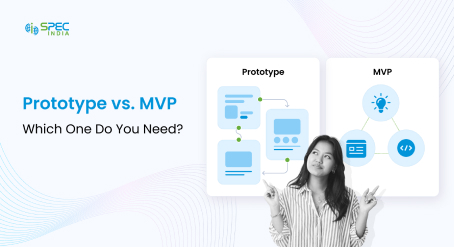

Let’s get in touch!
India
SPEC House, Parth Complex, Near Swastik Cross Roads, Navarangpura, Ahmedabad 380009, INDIA.
-
 +91-79-26404031, 32-33-34
 -
 [email protected]