| Feature | React Native | Native Development |
|---|---|---|
| Codebase | Single codebase for iOS and Android | Separate codebase for each platform |
| Cost of Mobile App Development | Lower, since one team builds both apps | Higher, due to two specialized teams |
| Development Time | Faster, thanks to code reuse | Slower, with parallel native builds |
| Performance | Near-native for most business apps | Fully native, best for complex apps |
| Maintenance | Easier, one codebase to update | Harder, two codebases to maintain |
| Best For | Startups, MVPs, and most business apps | Games, AR/VR, high-performance apps |
| Developer Availability | Large JavaScript talent pool | Requires separate iOS and Android specialists |
| Code Reusability | High across platforms | Limited between platforms |
| Third-party Integrations | A wide range of ready-to-use libraries | Direct integration with platform SDKs |
| Long-term Maintenance | Easier with one shared codebase | More effort is required to manage separate projects |


Loading...
React Native for Mobile App Development: Benefits, Cost & Best Use Cases

Businesses today want faster app launches without stretching their budgets. React Native app development can help to do both. The teams can work from a single codebase because they do not need to create separate apps for iOS and Android devices. This reduces the development time and expenditure. Therefore, it is an option that startups and enterprises are increasingly selecting. Many mobile app customization providers also claim it is indispensable for a quicker product launch.
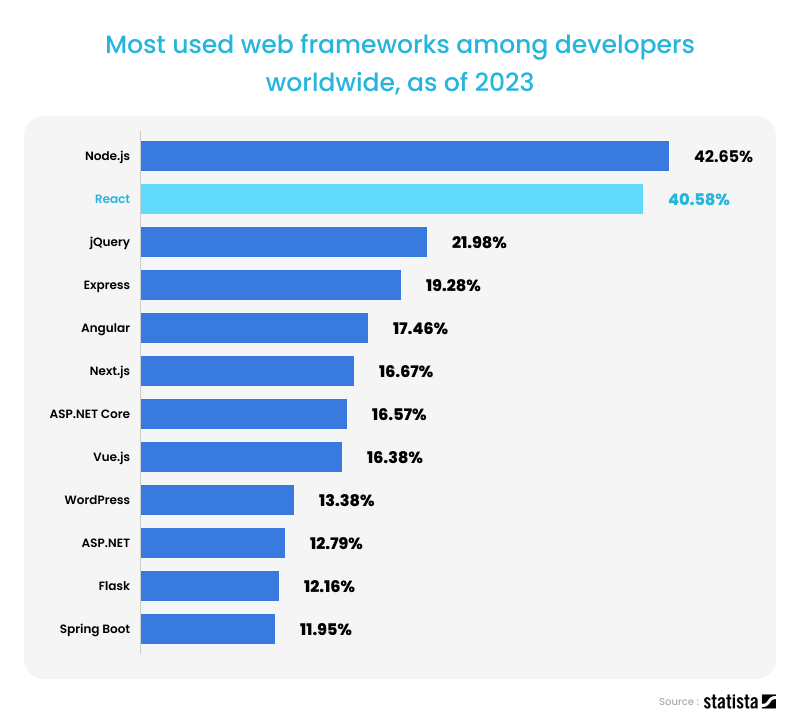
React Native keeps on growing. At React Conf 2025, the team revealed that React had 2 million weekly downloads. This number was double that of the previous year’s total. Meta open-sourced React Native in 2015, and today it is supported by one of the largest open-source mobile development communities.
Several enterprises wonder whether building React Native apps for phones is worth it. So, it all depends on the objectives, budget, and product requirements. This guide should help you understand how best to use React Native, what it can’t do, and when it is best suited.
By the end of this guide, you’ll understand when React Native is the right choice, where it delivers the most value, and how to decide whether it’s the right framework for your next mobile app project.
Why React Native App Development is Still a Popular Choice in 2026
Mobile app development companies have always used business frameworks, and React Native has been the preferred choice over the years. As a result, speed, flexibility, and cost are properly balanced. That’s why, even though it is popular, most businesses have continued to use it to create high-quality mobile applications with a single codebase.
Furthermore, businesses considering React Native to develop their applications will find a well-established environment and methodology for creating reliable apps.
Backed by Meta and a Mature Ecosystem
Meta continues to develop React Native and uses it in several of its products. That increases the business’s confidence regarding investing in the framework. Delivering a mature React Native ecosystem also reduces development risks and shortens the delivery timeline.
Key advantages include:
- Long-term support from Meta and the open source community
- Thousands of ready-to-use libraries and productivity tools
- Easy integration with existing systems and third-party services
- A mature ecosystem that supports startups, SMBs, and enterprise-grade mobile applications.
Faster Development with a Shared Codebase
The rewards of using React Native include a common codebase. The React Native app developers create features once and deploy them on both iOS & Android. In the workflow, this saves a lot of time during the project’s development.
Businesses benefit from:
- Faster MVP and product launches
- Lower development and testing efforts
- Quicker testing and feature releases
- A streamlined mobile app development process with fewer duplicate tasks
Strong Community and Continuous Improvements
React Native is still expanding, undergoing continuous updates and development by developers around the globe. This active association maintains a steady and secure structure, with all the requirements for contemporary business use.
Why this matters:
- Frequent improvements and bug fixes
- Updated documentation and learning resources
- Access to modern libraries and development practices
- Better long-term support for scalable mobile applications
This combination of orchestrated performance, community support, and quick releases ensures that React Native remains relevant in 2026.
Is React Native Good for Your Mobile App? Key Factors to Consider
All native apps are designed to meet various business objectives and technological requirements. Test a framework before selecting it to ensure it is effective in the key areas of interest. Here are five key factors to consider when deciding on React Native app development.
1. Development Speed & Time-to-Market
Speed is one of the biggest determinants of getting to your customers and testing your ideas. Having a single codebase for iOS and Android makes it easier for app development using React Native. This is a good solution for businesses aiming to enter the market early by developing a React Native mobile app.
Here’s how it speeds up delivery:
- One shared codebase reduces duplicate development work.
- Hot Reload shows code changes almost instantly.
- Reusable UI components improve developer productivity.
- Faster MVP launches help businesses validate ideas earlier.
- Streamlined mobile app development with React Native keeps projects on schedule.
2. Performance for Real-World Applications
A majority of business native apps aren’t heavily graphics- or processing-reliant. For business use, React Native provides for smooth performance. New mobile app architecture also enhances interaction between JavaScript and native code, reducing idle time and improving responsiveness.
Performance remains strong for:
- Business, retail, healthcare, and service applications
- Smooth navigation and responsive user interactions
- Apps with moderate animations and business logic
- Faster rendering through improved framework architecture
- Complex games or graphics-heavy applications may still benefit from fully native development.
3. Cost Savings Without Compromising Quality
Developing the entire app rather than two will reduce development and maintenance costs. There is also a reduction in the cost to the business in employing and sustaining a long-term allegiance. Partnering with a React Native mobile app development company is appealing to startups and expanding businesses alike.
Key cost advantages include:
- Smaller development teams
- Lower maintenance efforts
- Faster feature releases across both platforms
- Better return on development investments
- Simplified testing and ongoing updates
4. User Experience: Can Users Tell the Difference?
Users are interested in how it works but not in “how fast”. Typically, users care more about how easy and quick the application is to use and how reliable it is, rather than about the technologies it uses. What React Native does is essentially leverage the same native UI components to create a sturdy interface that feels like the local one (familiar across multiple platforms) while also being customizable for platforms simultaneously.
Users benefit from:
- Smooth navigation across screens
- Responsive animations and interactions
- Native look and feel on each platform
- Consistent experiences across iOS and Android
- Flexible customization for platform-specific features
5. Scalability for Growing Businesses
You want your app to grow in the future without having to rebuild it. Expand features, build connections to custom mobile app development services, and access and use one codebase more readily with React Native. Apart from this, many companies also opt for React Native, as it is helpful for future product development.
React Native scales through:
- Easy code reuse for future features
- Integration with backend systems and APIs
- Simpler maintenance over time
- Support for growing user bases
- Flexible architecture for future business needs
These five things explain why React Native remains a viable option for businesses looking to create their native apps faster, at lower cost, and with long-term scalability.
Ready to Build Your Cross-Platform App?
Grow with a trusted partner to develop a rapid, secure, and scalable cellular application for any enterprise. Partner with us today!
When React Native Is the Right Choice
While React Native is great for many business applications, it is at its best in certain situations. If your priority is faster development, cost efficiency, and long-term scalability, React Native is an excellent choice
Startup MVPs
The process for startups is to validate ideas before making a considerable investment. React Native for mobile app development helps a business visionary quickly test their MVP, gather client input, and fine-tune their product without building two apps.
Why it works well:
- Lower upfront cross-platform app development costs
- Faster product validation
- Easy feature updates based on user feedback
Enterprise Business Apps
For large organizations, secure, dependable applications that perform across devices and groups are required. Large organizations use React Native to build secure, scalable, and maintainable enterprise applications that deliver a consistent experience across iOS and Android.
Enterprise benefits include:
- Consistent user experience across platforms
- Faster deployment of new business features
- Simplified maintenance with a shared codebase
E-commerce Applications
Shopping apps need fast navigation, secure checkout, and reliable performance. React Native handles these everyday requirements while reducing development time. Businesses can also hire mobile app developers to build a single application for both major platforms.
Ideal for features like:
- Product catalogs and search
- Shopping carts and secure payments
- Order tracking and customer accounts
Healthcare Apps
Regular updating, robust security, and reliability are essential for healthcare applications. React Native makes maintenance easy and supports integrations with healthcare back-end systems and platforms.
Common use cases include:
- Appointment booking
- Telemedicine applications
- Patient portals and health tracking
FinTech Solutions
The highest standards of security, reliability, and continuous improvement are required in financial applications. React Native offers secure payment processing capabilities and simplifies feature updates through a shared codebase.
Suitable for:
- Digital wallets
- Banking applications
- Investment and payment platforms
On-demand Service Apps
Real-time communication is essential for delivery, booking, and ride-sharing apps. React Native makes these experiences possible and simple through stable integrations with React Native chat libraries, eliminating the need for customer interactions.
Popular examples include:
- Food delivery apps
- Taxi booking platforms
- Home service marketplaces
As we see in the instances above, using React Native is a prudent move. It helps build scalable, customer-centric mobile applications for businesses.
Example of an App Built with React Native
Here are a few examples of popular apps built with React Native, showcasing its versatility and capability to deliver high-quality mobile experiences across different industries.
Meta (Facebook)
Meta developed React Native to accelerate cross-platform mobile development while maintaining native performance. Today, React Native powers several experiences across Meta’s ecosystem and continues to evolve through active investment from the company and the open-source community.
Instagram adopted React Native to improve development efficiency and reuse code across iOS and Android. It enables faster feature delivery while maintaining the smooth user experience expected by millions of users worldwide.
Shopify
Shopify uses React Native extensively to deliver consistent mobile experiences while accelerating feature development across platforms. Its engineering team has contributed significantly to improving React Native for large-scale production applications.
Discord
Discord relies on React Native to provide a fast, reliable, and consistent communication experience across mobile platforms while supporting millions of active users worldwide.
When React Native May Not Be the Best Option
React Native handles most business applications with ease. However, no framework is perfect for every project. Some apps require maximum hardware access or specialized graphics capabilities. For these reasons, when requirements are complex, with performance and control constraints, or when platform-specific functionality is desired, full native development is preferable.
- Graphics-intensive games: These games require native code for advanced graphics, high frame rates, and real-time rendering.
- Augmented/Virtual Reality applications: AR/VR apps must have direct access to device sensors, cameras, and graphics APIs to create a seamless, immersive experience.
- Heavy 3D rendering applications: These React Native apps can handle complex 3D models, simulations, or visual effects and benefit from native rendering technology.
- First-party apps built on advanced platform APIs: Enterprise or hardware-based apps rely on powerful platform-specific APIs that aren’t natively supported by React Native and require platform-specific micro-management.
React Native’s New Architecture has reached 80% adoption. This comes from the State of React Native 2025 survey, closed in January 2026. Even so, extreme cases like heavy 3D and AR/VR still favor native development.
React Native vs Native App Development
There’s no such thing as a best cross-platform framework, though there’s a very good reason to consider both React Native and the native approaches. It’s time to do the right thing for your company. Consider the budget, launch date, performance expectations, maintenance, and future growth plans before committing. The following comparison lists some of the main differences.
There isn’t a one-size-fits-all answer. React Native is an ideal choice for almost any business application seeking speed, cost-effectiveness, and cross-platform functionality. For hardware- or graphics-intensive applications, React Native alternatives are still the best option. A dependable mobile app development firm with experience in React Native can help you assess both approaches before development.
| Quick Tip: React Native might be the sensible option if your app is built around your business functions, customer interactions, eCommerce, or content delivery. When it requires complex graphics, heavy processing, or integration into the hardware itself, it is generally better to choose native development. |
React Native vs Flutter: Which Framework Should You Choose?
The decision between React Native and Flutter will depend on your team’s skills, your app’s goals, and how you plan to maintain the product over time. Both frameworks can be used for cross-platform applications, but each has its own merits. It will help you decide whether to use technology, based on how it differs from others, rather than following the latest industry trends.
| Feature | React Native | Flutter |
|---|---|---|
| Native Languages | JavaScript and TypeScript | Dart |
| UI Approach | Uses UI native components | Uses its own rendering engine |
| Performance | Near-native, improved by New Architecture | Fast and consistent across platforms |
| Community | Large, backed by Meta and JavaScript developers | Large, backed by Google |
| Best For | Teams with React or JavaScript experience | Teams wanting pixel-perfect, consistent UI |
| Learning Curve | Easier for JavaScript developers | Requires learning Dart |
| Third-party Libraries | Extensive JavaScript ecosystem | Growing Flutter package ecosystem |
| Native Integration | Easier access to existing native modules | Supports native integration with platform channels |
| Development Talent | Larger global developer pool | Smaller but rapidly growing community |
A skilled React Native mobile application developer can assess your technology goals, your current tech stack, and plans, and then select the appropriate framework. It’s not about which of the various technologies to pursue is popular; it’s about your business priorities and what Native components and Native modules you wish to use.
| Quick Tip: If your team has JavaScript skills or expects to leverage those skills in a Web development interface, select React Native. If you want UI consistency across all platforms, then Flutter is a good option. |
React Native App Development Cost
The cost of app development can vary significantly depending on several factors, including the complexity of the app, the features and functionalities required, the platform(s) it will be developed for (iOS, Android, or both), the geographic location of the development team, and the hourly rates of the developers.
Here are some general cost estimates for React Native app development:
| React Native App Type | Application Examples | Estimated Cost | Estimated Time Frame |
|---|---|---|---|
| Simple | Calculator, Notes, Utility Apps | $15,000 – $20,000 | 3-6 Months |
| Medium | Healthcare, Retail, Booking Apps | $20,000 – $60,000 | 6-9 Months |
| Complex | FinTech, Logistics, SaaS Apps | $60,000 – $150,000+ | 9-12 Months |
| Enterprise Level | Banking, ERP, Enterprise Platforms | $150,000+ | 12-15 Months |
It’s important to note that these are just rough estimates, and the actual cost can vary based on the specific requirements of the project. Additionally, ongoing maintenance and updates should also be factored into the overall cost of app development.
To get a more accurate estimate, it’s recommended to consult with a professional React native app development company and provide them with detailed information about your project requirements.
Common Myths About React Native
React Native has evolved significantly over the years, but many businesses still judge it based on outdated information. The framework has improved through regular updates, better Native performance, and a stronger ecosystem.
Let’s separate the facts from the common misconceptions.
| Myth: “React Native apps are slow.” |
| Reality: Native performance has improved significantly with the New Architecture. Most React Native business apps now deliver a smooth and responsive experience. Users rarely notice any difference during everyday interactions. |
| Myth: “React Native can’t scale.” |
| Reality: Many global businesses continue to grow their react native apps without rebuilding from scratch. The React framework supports long-term maintenance, feature expansion, and growing user bases. |
| Myth: “You can’t build enterprise apps with React Native.” |
| Reality: Many organizations rely on React Native for app development, building both secure internal tools and customer-facing applications. With the right architecture, it supports enterprise requirements just as effectively as many other modern frameworks. |
Frameworks evolve quickly, and many opinions found online are based on much older versions. Always evaluate React Native against its current capabilities rather than assumptions formed several years ago. Most of these misconceptions come from React Native’s early years. Today’s framework is far more mature, stable, and capable than many people realize.
So, Is React Native Good for Mobile App Development?
By now, you’ve seen where React Native performs well and where it may not be the ideal fit. The right choice depends on your business priorities, technical requirements, and long-term plans. Use this simple checklist to decide whether React Native aligns with your project.
1. Budget
React Native is a smart option if you want to control development costs without sacrificing quality. A shared codebase reduces the need for separate development teams and simplifies long-term maintenance.
Choose React Native if you:
- Want to maximize your development budget
- Need one team to build for both platforms
- Prefer lower maintenance costs over time
2. Timeline
If speed is a priority, React Native helps you launch sooner. Faster development, quicker testing, and shared code allow teams to release updates more efficiently.
It works well when you:
- Need to launch an MVP quickly
- Plan frequent feature releases
- Want shorter development cycles
3. Performance Needs
Most business applications perform smoothly with React Native. However, apps with intensive graphics, advanced animations, or deep hardware integration may benefit from native development.
Ask yourself:
- Does your app require graphics-intensive processing?
- Will it rely on advanced device capabilities?
- Are platform-specific features critical to the experience?
4. Target Audience
If your customers use both iOS and Android apps, React Native lets you deliver a consistent experience across both platforms while avoiding the cost of maintaining separate native apps.
It’s a strong choice when you want to:
- Reach users on both platforms
- Deliver a consistent user experience
- Reduce duplicate development efforts
5. Future Scalability
Your technology should support future business growth, not limit it. React Native makes it easier to add features, expand integrations, and support a growing user base. According to Statista, React.js usage reached 44.7% among developers in 2025, showing continued confidence in the JavaScript ecosystem behind React Native.
Consider React Native if you expect to:
- Add new features regularly
- Expand your customer base
- Integrate with more business systems over time
Before making a final decision, bring both your technical and business stakeholders into the discussion. Review your budget, launch timeline, expected user growth, future integrations, and maintenance requirements. Selecting the right framework early helps reduce technical debt, avoid costly redevelopment, and keep your application easier to scale as business needs evolve.
Benefits of React Native App Development
When it comes to software development, cross-platform is the pinnacle of excellence since it allows you to construct your codebase only once and operate it on any platform, unlike native software.
Developers can create unfamiliar platforms by using the tools they are familiar with, such as JavaScript or C#.
The owners of software are also excited about it because it reduces costs and time to market for product creation by half. What qualities does cross-platform development possess?
React Native continues to be one of the most popular cross-platform frameworks because it combines development speed, cost efficiency, and near-native performance. Here are the key benefits businesses can expect.
Wider Audience
Cross-platform software operates on both iOS and Android, so you can reach a larger user base without having to choose which audience to target.
Platform consistency
Cross-platform development resolves design and navigation differences between iOS and Android with a shared codebase.
As opposed to being developed on two different native apps, this makes it easier to have a consistent app brand identity across both platforms with less work.
Hot Reloading
React Native supports hot reloading, which allows a react native developer to see changes to their code in real-time without having to rebuild the entire app.
This speeds up the development process and allows for faster iteration.
Near-Native Performance
React Native uses native components, which allows for better performance compared to other cross-platform frameworks.
This means that React Native apps can offer a smooth and responsive user experience.
Large Community and Ecosystem
React Native has a large and active community of developers, which means that there are plenty of resources and libraries available to help with app development.
This can help to find solutions to common problems quickly.
Cost Effective
Because React Native allows developers to write code once, it can be more cost-effective than developing separate codebases for each platform.
This can be especially beneficial for startups and small businesses with limited resources.
Support for Third-Party Plugins
The bare minimum React Native framework lacks certain essential elements.
It guarantees that third-party plugins, including native and JavaScript modules, are available to developers in exchange for compensation.
For instance, React Native enables a developer to link the plugin to a third-party/native module if they want to incorporate Google Maps into their project.
How to Choose a React Native Development Company?
There are a few things that you should check while selecting a React Native app development company, and make sure to take care of these points while selecting.
- Experience and Expertise: Seek out a company with a proven track record of delivering successful React Native projects. Their portfolio and client testimonials should speak volumes about their expertise.
- Team Composition: A top-notch React Native development company should boast a team of highly skilled developers, designers, and project managers. This diverse talent pool ensures that your project is in capable hands.
- Communication and Collaboration: Effective communication is paramount. Look for a company that is responsive, transparent, and open to collaboration. This ensures that your vision is understood and executed flawlessly.
- Quality Assurance: A robust quality assurance process is essential to ensure the final product meets your expectations. The company should rigorously test the app on various devices and platforms to ensure compatibility and performance.
- Cost and Budget: While cost is a factor, prioritize quality over price. Make sure to consider a company that offers competitive rates without compromising on quality.
- Support and Maintenance: Ongoing support and maintenance are crucial for the long-term success of your app. Choose a company that offers the best React native mobile app development services to keep your app up-to-date and functional.
- Client References: Speaking to past clients can provide valuable insights into the company’s work ethic and professionalism. Don’t hesitate to ask for references and testimonials.
- Scalability: A company’s ability to scale up or down based on your project’s needs is essential. They should be able to accommodate changes in scope or requirements without compromising on quality or timelines.
Ready to Start Your React Native Project?
Work with an experienced team that builds secure, scalable, and cost-effective mobile apps tailored to your needs.
Conclusion
React Native continues to be a smart choice for businesses that want faster launches, lower development costs, and a consistent experience across iOS and Android phones. It works especially well for startups, growing businesses, enterprise applications, eCommerce platforms, healthcare solutions, and many other business apps. If your goal is to build a scalable app without maintaining two separate Native apps and codebases, React Native is worth serious consideration.
That said, every project is different. If your app depends on graphics-intensive processing, AR/VR experiences, or advanced platform-specific capabilities, React Native app development may deliver better long-term results. Evaluate your business goals, technical requirements, and plans before making a decision. Choosing the right framework today will help you build a reliable, scalable, and future-ready mobile application.
Frequently Asked Questions
The to develop React Native app can vary widely, but on average, it can cost anywhere from $10,000 to $500,000. The cost depends on factors such as complexity, features, platforms, and location.
React is a popular JavaScript library for building user interfaces for web applications, while React Native is a framework for building mobile applications using JavaScript and React. If you want to build a web application, react is a good choice. If you want to build a mobile application, React Native is a good choice.
Some future trends of React Native include:

SPEC INDIA is your trusted partner for AI-driven software solutions, with proven expertise in digital transformation and innovative technology services. We deliver secure, reliable, and high-quality IT solutions to clients worldwide. As an ISO/IEC 27001:2022 certified company, we follow the highest standards for data security and quality. Our team applies proven project management methods, flexible engagement models, and modern infrastructure to deliver outstanding results. With skilled professionals and years of experience, we turn ideas into impactful solutions that drive business growth.
Table of contents
- Why React Native App Development is Still a Popular Choice
- Is React Native Good for Your Mobile App
- When React Native Is the Right Choice
- Example of an App Built with React Native
- When React Native May Not Be the Best Option
- React Native vs Native App
- React Native vs Flutter
- React Native App Development Cost
- Common Myths About React Native
- Is React Native Good for Mobile App Development
- Benefits of React Native App Development
- How to Choose a React Native Development Company
- Conclusion
Delivering Digital Outcomes To Accelerate Growth
Let’s TalkTable of contents
- Why React Native App Development is Still a Popular Choice
- Is React Native Good for Your Mobile App
- When React Native Is the Right Choice
- Example of an App Built with React Native
- When React Native May Not Be the Best Option
- React Native vs Native App
- React Native vs Flutter
- React Native App Development Cost
- Common Myths About React Native
- Is React Native Good for Mobile App Development
- Benefits of React Native App Development
- How to Choose a React Native Development Company
- Conclusion
Delivering Digital Outcomes To Accelerate Growth
Let’s Talk


Let’s get in touch!
India
SPEC House, Parth Complex, Near Swastik Cross Roads, Navarangpura, Ahmedabad 380009, INDIA.
-
 +91-79-26404031, 32-33-34
 -
 [email protected]