| React Native App Type | Estimated Cost | Estimated Time Frame |
|---|---|---|
| Simple | $15,000 – $20,000 | 3-6 Months |
| Medium | $20,000 – $60,000 | 6-9 Months |
| Complex | $60,000 – $150,000+ | 9-12 Months |
| Enterprise Level | $150,000+ | 12-15 Months |


Loading...
React Native App Development: A Detailed Guide

React Native has gained significant attention among the developers’ community.
In the future also it will get the same due to its ability to provide developers the flexibility to use javascript and react both to build mobile applications.
This guide is designed to provide you with a detailed understanding of React Native and how it can be used to build powerful and versatile mobile applications.
We’ll cover everything you need to know about React Native, from its origins and core concepts to its benefits, challenges, and best practices. We’ll also provide you with real-world examples and case studies to help you understand how React Native can be used in practice.
But before we dive into the nitty-gritty, let’s take a moment to appreciate the impact React Native has had on the mobile app development landscape.
You can choose a React Native app development company and you will get to know that the demand for developing a React Native App is quite high in the market.
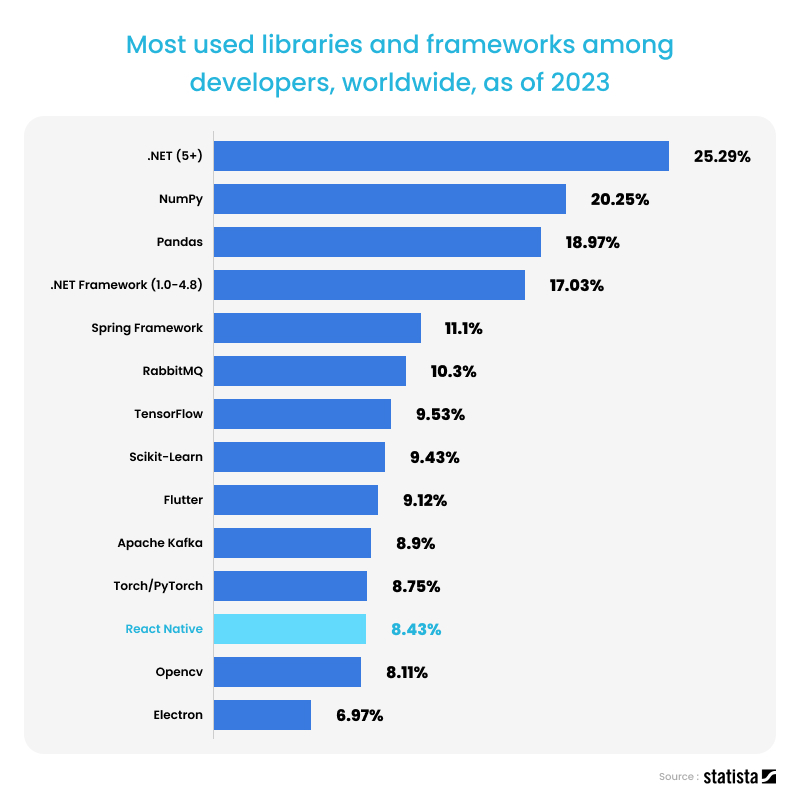
With a 42.62% market share, React Native is the 2nd most popular framework for developing cross-platform mobile apps. Even in 2024, React Native remains a popular option. Node JS comes first in the list.
That’s a staggering number, and it speaks volumes about the popularity and effectiveness of this framework.
And it’s not just about the numbers. React Native has been embraced by some of the biggest names in tech, including Facebook, Instagram, and Airbnb.
These companies have all used React Native to build their mobile apps, and they’ve seen incredible results. For example, Facebook’s mobile app is built entirely with React Native, and it’s been downloaded over 2 billion times!
So, Why is React Native so Popular?
Well, for starters, it allows developers to reuse the code, which can be used on multiple platforms, including iOS and Android.
This saves time and resources, as a React Native Developer doesn’t write separate codebases for each platform.
They only have to write code for once, and they can use it for multiple platforms.
Plus, React Native apps are compiled into native code, which means they run at near-native speeds.
But it’s not just about the technical benefits. React Native also has a thriving community of developers who are constantly pushing the boundaries of what’s possible.
There are thousands of open-source libraries and components available, which makes it easy to add new features and functionality to your app.
In short, React Native is a game-changer for mobile app development. It’s fast, efficient, and incredibly powerful. So, if you’re ready to take your mobile app to the next level, dive into our guide and discover everything you need to know about React Native development.
If you are looking to develop a React native app and are looking for answers to whether it would be a good choice for your app or not, just stay tuned. This blog will give you all the answers.
Proceeding further let’s check out the most used libraries and frameworks around the world.
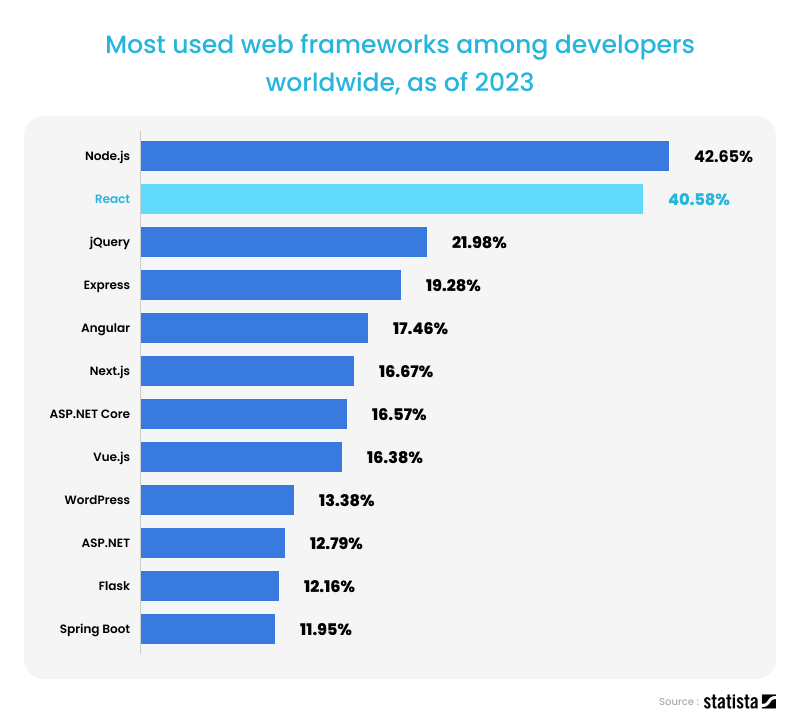
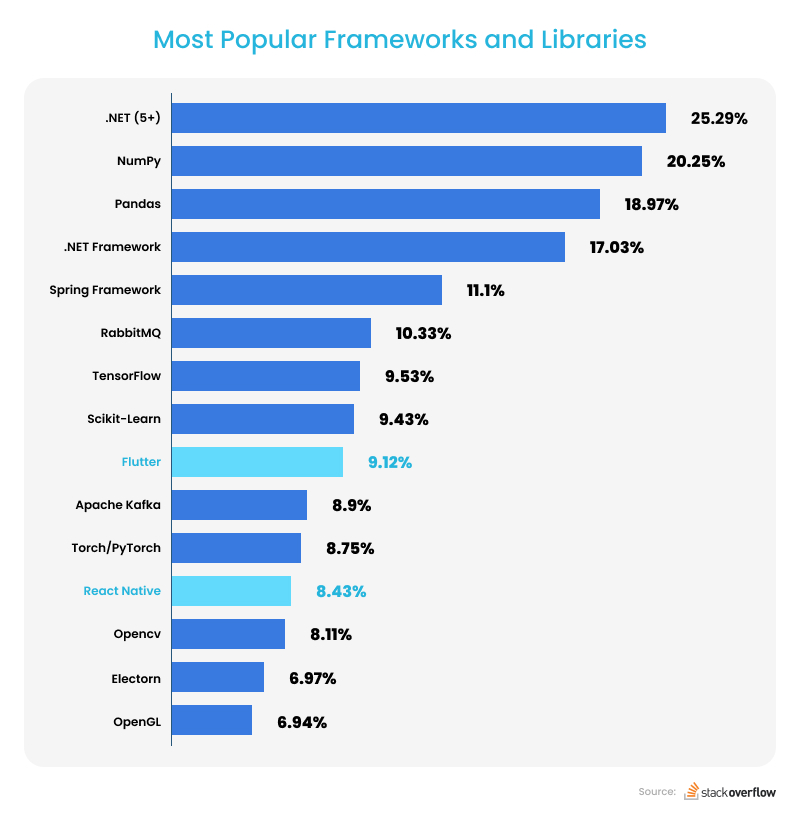
Let’s check out the most used libraries and frameworks among developers worldwide as of 2023, and where React Native stands in this list.
What is React Native?
React Native is an open-source framework developed by Facebook that allows developers to build mobile applications using JavaScript and React.
React Native works by using a bridge that allows JavaScript code to communicate with native platform APIs.
This bridge enables a React Native Developer to access native features and components, such as cameras, GPS, and push notifications, while still writing code in JavaScript.
React Native is primarily used for building mobile applications.
It is particularly well-suited for applications that require a high level of performance, such as gaming or video streaming apps.
It is also a popular choice for companies looking to develop cross-platform applications, as it allows them to save time and resources by writing code once and deploying it across multiple platforms.
If you use React Native, you only need to build a JavaScript application once.
On the contrary, using a native technique requires starting from scratch with two apps: one for iOS and one for Android.
To build with React Native, you must have two teams of developers writing code.
However, this investment pays off twofold with significant savings on development and upkeep.
How Does React Native Work?
Imagine you are a chef in a kitchen, and you want to make a delicious meal. You have all the ingredients you need, but you need to follow a recipe to put everything together in the right way.
The same applies to React native mobile app development, the kitchen is like your mobile device, and the ingredients are the different components and features you want to use in your app.
The recipe is the code you write to tell the app how to use those ingredients to create the final product.
Now, let’s say you are cooking a dish that requires you to use a special tool that you don’t have in your kitchen.
You could go out and buy that tool, but it would take time and money.
Instead, you decide to use a different tool that you already have, but it’s not quite the same. You will need to make some adjustments to the recipe to account for the differences.
In this analogy, the special tool is a native feature or component that is specific to one platform, like iOS or Android. The tool you already have is React Native, which allows you to use JavaScript to access those native features and components.
So, when you are cooking with React Native, you are using JavaScript to follow the recipe and create the final product, but you are also using the bridge to access native features and components that you would not be able to use otherwise.
And just like in cooking, there are some things that React Native can’t do as well as a native tool.
For example, if you are cooking a dish that requires a lot of precision, you might want to use a special tool that is designed specifically for that purpose.
Similarly, if you are building an app that requires a lot of complex animations or interactions, you might want to use a different tool that is better suited to those tasks.
But for many apps, React Native is a great choice because it allows you to use JavaScript to access native features and components, which can save you time and money.
And just like in cooking, the more you practice and experiment with React Native, the better you will get at using it to create delicious apps!
When to Use React Native
To identify the requirements of a project and the target platforms for using React Native, the first step is to gather information about the project.
This includes understanding the goals, scope, and specific needs of the project.
Next, analyze the key requirements of the project.
This involves determining the functionality, features, and performance expectations.
Consider the desired user experience, any technical constraints, and integration with existing systems or services.
By understanding the requirements, you can determine whether React Native is a suitable choice.
Once the requirements are clear, it is important to identify the target platforms for the project. React Native allows for cross-platform development, supporting both iOS and Android.
However, there may be specific considerations or limitations for each platform.
Evaluate factors such as the target audience, market share, platform-specific features, and performance requirements to make an informed decision.
Considering that React Native offers the advantage of code reusability between platforms, it is often a preferred choice for projects that require efficient development and maintenance.
It is especially beneficial when the project requires frequent updates or has a limited development timeline.
Evaluate the complexity and nature of the project.
To evaluate the complexity and nature of a project, it is important to consider several factors.
These factors include the project requirements, the target audience, the available resources, and the level of expertise of the development team.
In the case of when to use React Native, there are a few things to consider.
- React Native is a popular framework for building cross-platform mobile applications using JavaScript. It allows developers to write code once and deploy it on both iOS and Android platforms.
- The complexity of the project plays a crucial role in determining whether React Native is a suitable choice.
- If the project requires complex user interfaces, heavy animations, or advanced native features, React Native might not be the best fit.
- In such cases, a native development approach may be more appropriate to achieve the desired level of performance and flexibility.
- Additionally, the nature of the project and the target audience should be considered.
- If the project primarily focuses on delivering a seamless user experience with native-like performance, React Native may not be the ideal choice.
- Native development would be better suited in scenarios where platform-specific capabilities and performance optimizations are essential.
However, there are situations where React Native shines.
If the project has a limited budget and time constraints, React Native can be a great choice as it allows for faster development and easier maintenance compared to separate native codebases.
React Native also provides a large ecosystem of pre-built components and libraries, making it easier to develop certain types of applications, such as content-based or data-driven apps.
Determine if the project requires a high level of performance or access to native features.
To determine if a project requires a prominent level of performance or access to native features, we need to consider the specific requirements and goals of the project.
If the project requires a high level of performance and demands complex animations, heavy calculations, or real-time interactions, it may be beneficial to use a language that allows for fine-grained control over performance, such as native development using languages like Java or Swift.
This is because native development gives direct access to the device’s resources and can optimize performance to a greater extent.
On the other hand, if the project does not have demanding performance requirements and does not heavily rely on device-specific functionalities, using React Native could be a suitable option.
It simplifies the React Native mobile app development process by enabling the reuse of code and components across different platforms.
However, if the project heavily depends on accessing native features like the camera, GPS, Bluetooth, or specific hardware capabilities, it may be more appropriate to choose native development.
While React Native provides access to many native modules and APIs, there may be limitations or delays in accessing certain functionalities. Native development allows for direct integration with native code and provides full access to all device-specific features.
Check out the most used web frameworks among developers worldwide, as of 2023
Decide whether to use React Native mobile app development based on the evaluation.
Based on the overall objective of “When to Use React Native” and the sub-task of deciding whether to use React Native based on the evaluation, I have taken the following steps to complete the task.
Make notes and mark right in front of the processes that you complete.
These are the steps you have to take care of while choosing to react to native mobile app development.
Researched React Native: Research React Native to understand its purpose, features, and benefits.
React Native is a popular framework for building mobile applications using JavaScript.
It saves time and effort by allowing developers to use code multiple times.
Consider the Project Requirements: Check whether you have carefully evaluated the project requirements to determine if React Native is the right choice.
React Native is ideal for projects that require cross-platform compatibility and need to be developed rapidly.
It offers a wide range of pre-built components and libraries, making development faster and more efficient.
Assessed the Team’s Expertise: Consider the expertise of your development team.
React Native requires proficiency in JavaScript and React concepts.
If the team is already familiar with these technologies or has previous experience with React Native, it would be advantageous to use them.
Evaluated Performance and Native Capabilities: Evaluate the performance and native capabilities required for the project.
While React Native provides a native-like experience, it may not match the performance and capabilities of fully native applications in certain scenarios.
If the project demands extensive hardware interaction or performance optimization, choosing native development might be more suitable.
Analyze Time and Budget Constraints: Analyze the time and budget constraints of the project.
React Native can significantly reduce development time and cost compared to separate native development for iOS and Android.
If there is a tight deadline or limited budget, choosing React Native would be a favorable option.
Evaluate The Performance Requirements of The Project
To evaluate the performance requirements of a project, several factors need to be considered.
Here are the steps to follow –
- Identify the Key Performance Metrics: Determine the specific metrics that are relevant to the project. This could include factors like response time, load time, memory usage, CPU utilization, network latency, and battery consumption.
- Set Performance Goals: Establish clear performance goals for each identified metric. These goals should align with the project requirements and user expectations. For example, a goal could be to ensure that the application loads within 2 seconds on average.
- Conduct a Performance Analysis: Use appropriate tools and techniques to measure the performance of the project. This may involve running performance tests, profiling the code, and analyzing the results. Consider using tools like React Native’s built-in performance monitor or third-party tools like Flipper or Reactotron.
- Identify Bottlenecks: Analyze the performance results to identify any performance bottlenecks or areas of improvement. This could include slow rendering, excessive network requests, inefficient algorithms, or memory leaks. Prioritize the identified issues based on their impact on user experience and resource consumption.
- Optimize Performance: Based on the identified bottlenecks, take appropriate steps to optimize the performance of the project. This could involve refactoring the code, implementing caching mechanisms, reducing unnecessary network requests, improving algorithms, or optimizing resource usage. Keep in mind the performance trade-offs and consider the impact on maintainability and code simplicity.
- Test and Validate the Optimizations: After implementing the performance optimizations, run tests again to ensure that the desired performance goals have been achieved. Monitor key performance metrics and compare them against the established goals. Make further adjustments if necessary.
- Document the Performance Requirements and Optimizations: Record the identified performance requirements, goals, bottlenecks, and optimizations in a performance report. This documentation will serve as a reference for future development and maintenance of the project.
React Native App Development Cost
The cost of app development can vary significantly depending on several factors, including the complexity of the app, the features and functionalities required, the platform(s) it will be developed for (iOS, Android, or both), the geographic location of the development team, and the hourly rates of the developers.
Here are some general cost estimates for React Native app development:
It’s important to note that these are just rough estimates, and the actual cost can vary based on the specific requirements of the project. Additionally, ongoing maintenance and updates should also be factored into the overall cost of app development.
To get a more accurate estimate, it’s recommended to consult with a professional React native app development company or freelancer and provide them with detailed information about your project requirements.
Example of an App Built with React Native
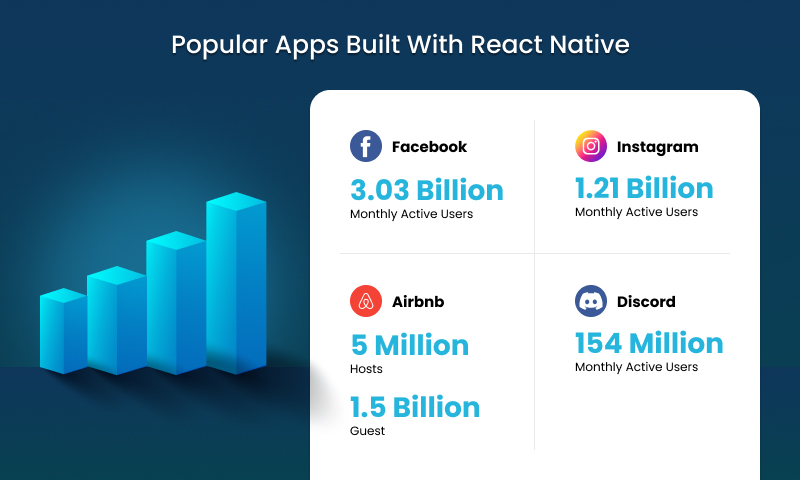
Here are a few examples of popular apps built with React Native, showcasing its versatility and capability to deliver high-quality mobile experiences across different industries.
Meta (Facebook)
- Facebook, which is now Meta, is a social media platform founded by Mark Zuckerberg in 2004.
- It allows users to connect with friends, share content, and communicate through posts, messages, and comments.
- React Native was used in developing Facebook’s mobile app.
- It is available on both iOS and Android devices, and users can also access it through a web browser.
- Facebook has over 3.03 billion monthly active users worldwide, making it one of the most popular social media platforms globally.
- Instagram is a social media platform where users share photos and videos.
- It was created in 2010 and acquired by Facebook in 2012.
- Instagram has become one of the most popular social media platforms in the world, with over 1 billion monthly active users as of 2022.
- It was built using React Native, due to which they successfully grabbed user attention towards their interactive elements and smooth user interface.
- It is available on both iOS and Android devices.
- It’s popular for businesses, influencers, and personal use.
- In 2021, there were 1.21 billion monthly active users of Meta’s Instagram, making up over 28 percent of the world’s internet users. By 2025, it is forecast that there will be 1.44 billion monthly active users of the social media platform, which would account for 31.2 percent of global internet users.
Airbnb
- Airbnb is a popular online marketplace and hospitality service that allows people to rent or lease short-term lodging, including vacation rentals, apartment rentals, homestays, hostel beds, or hotel rooms.
- Airbnb was founded in August 2008 by Brian Chesky, Joe Gebbia, and Nathan Blecharczyk in San Francisco, California.
- The company has grown into a global phenomenon, with listings in over 220 countries and regions.
- Airbnb has used React Native extensively in its mobile app development, allowing it to create a consistent user experience across different platforms.
- Airbnb was born in 2007 when two Hosts welcomed three guests to their San Francisco home.
- Today, there are over 5 million Hosts who have welcomed over 1.5 billion guest arrivals in almost every country across the globe.
Discord
- Discord is a popular communication platform primarily used by gamers, but it has also found use in other communities.
- It was developed in 2015 by Jason Citron and Stanislav Vishnevskiy.
- React Native has played a significant role in Discord’s mobile app development.
- It has allowed Discord to provide a consistent user experience across different devices and operating systems.
- Discord had over 154 million monthly active users.
Read More: Top 25 Companies/Brands Using ReactJS Development
Benefits of React Native App Development
When it comes to software development, cross-platform is the pinnacle of excellence since it allows you to construct your codebase only once and operate it on any platform, unlike native software.
Developers can create unfamiliar platforms by using the tools they are familiar with, such as JavaScript or C#.
The owners of software are also excited about it because it reduces costs and time to market for product creation by half. What qualities does cross-platform development possess?
Well, build a React native app and get these benefits for your app.
Wider Audience
Cross-platform software operates on both iOS and Android, so you can reach a larger user base without having to choose which audience to target.
Platform consistency
Cross-platform development resolves design and navigation differences between iOS and Android with a shared codebase.
As opposed to being developed on two different native apps, this makes it easier to have a consistent app brand identity across both platforms with less work.
Hot Reloading
React Native supports hot reloading, which allows a react native developer to see changes to their code in real-time without having to rebuild the entire app.
This speeds up the development process and allows for faster iteration.
Native Performance
React Native uses native components, which allows for better performance compared to other cross-platform frameworks.
This means that React Native apps can offer a smooth and responsive user experience.
Large Community and Ecosystem
React Native has a large and active community of developers, which means that there are plenty of resources and libraries available to help with app development.
This can help to find solutions to common problems quickly.
Cost Effective
Because React Native allows developers to write code once, it can be more cost-effective than developing separate codebases for each platform.
This can be especially beneficial for startups and small businesses with limited resources.
Support for Third-Party Plugins
The bare minimum React Native framework lacks certain essential elements.
It guarantees that third-party plugins, including native and JavaScript modules, are available to developers in exchange for compensation.
For instance, React Native enables a developer to link the plugin to a third-party/native module if they want to incorporate Google Maps into their project.
Read More: 15 Best React UI Libraries to Speed Up Software Development
React Native: Risks and Drawbacks
While React Native offers many benefits for app development, there are also some risks and drawbacks to consider:
Performance Limitations: While React Native offers native performance for many tasks, there are some cases where it may not perform as well as a fully native app.
This is especially true for apps that require complex animations or heavy processing.
Limited Access to Native APIs: React Native provides access to many native APIs, but there may be cases where developers need to access a specific native API that is not supported by React Native.
In these cases, developers may need to write custom native code or use a third-party library.
Learning Curve: While React Native is based on JavaScript and React, there is still a learning curve for developers who are new to the framework.
This can make it more difficult for developers to get up to speed and start building apps quickly.
Dependency on Third-party Libraries: React Native relies on third-party libraries for many features, such as navigation and state management.
This can introduce additional complexity and potential risks, as developers may need to rely on external libraries that may not be well-maintained or supported.
Platform-specific Issues: While React Native aims to provide a consistent user experience across platforms, there may still be cases where developers need to write platform-specific code to handle differences between iOS and Android.
The alternative to React Native
React Native is itself better in most circumstances, but it does have alternatives that you can consider based on your specific needs and requirements.
Flutter: Flutter is a popular open-source framework for building mobile applications developed by Google. It uses the Dart programming language and offers several benefits, including a fast development cycle, a rich set of pre-built widgets, and a high-performance rendering engine.
Flutter offers a rich set of features that make it easy for developers to create custom UIs without having to write a lot of code.
It also offers a hot reload feature, which allows developers to see changes to their code in real-time without having to rebuild the entire app.
If you want to build highly customized and visually appealing apps, Flutter would be the best choice for you. I
Ionic: Ionic is a popular open-source framework for building mobile applications using web technologies such as HTML, CSS, and JavaScript.
Ionic offers a rich set of pre-built components, which makes it easy to create cross-platform apps with a consistent look and feel.
Ionic is a good choice for developers who are familiar with web development and want to build cross-platform apps quickly.
NativeScript: NativeScript is a popular open-source framework for building mobile applications using JavaScript and TypeScript.
NativeScript offers access to native APIs, which allows developers to build highly customized and performant apps.
It also offers a large community and ecosystem, which means that there are plenty of resources and libraries available to help with app development.
It is a good choice for developers who want to build highly customized and performant apps.
Xamarin: Xamarin is a popular open-source framework for building mobile applications using C# and .NET.
Xamarin offers access to native APIs, which allows developers to build highly customized and performant apps.
It also offers a large community and ecosystem, which means that there are plenty of resources and libraries available to help with app development.
Xamarin is an excellent choice for developers who are familiar with C# and .NET and want to build cross-platform apps quickly.
React Native Vs Flutter
Flutter and React Native are two popular frameworks for building mobile applications. Both have their own set of advantages and disadvantages, and the choice between them depends on your specific needs and requirements.
Here’s a comparison of Flutter and React Native in terms of performance:
- Performance: Flutter offers consistently high performance across platforms. It uses a high-performance rendering engine called Skia, which allows for smooth and responsive animations and transitions. React Native, on the other hand, offers native performance for many tasks, but there are some cases where it may not perform as well as a fully native app.
- UI Rendering: Flutter uses a custom rendering engine called Skia, which allows for smooth and responsive UI rendering. React Native uses a bridge to communicate with native components, which can introduce some overhead and affect performance.
- Hot Reload: Both Flutter and React Native offer hot reload, which allows developers to see changes to their code in real time without having to rebuild the entire app. This can help speed up the development process.
- Platform Support: Flutter supports iOS and Android, as well as other platforms such as web and desktop. React Native also supports iOS and Android, as well as other platforms such as Windows and macOS.
Both Flutter and React Native offer good performance, but Flutter may have a slight edge in terms of smooth and responsive UI rendering.
However, the choice between them depends on your specific needs and requirements.
If you’re looking for consistently high performance across platforms, Flutter may be a better choice. However, if you’re already familiar with JavaScript and React, React Native may be a better choice.
Who Is Using Flutter?
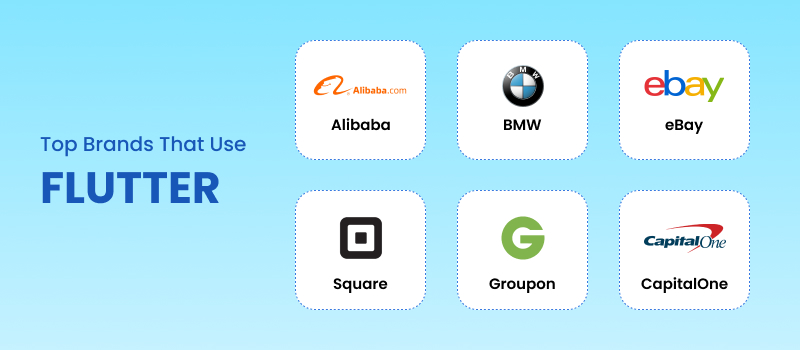
- Alibaba
- BMW
- eBay
- Square
- Groupon
- CapitalOne
Who Is Using React Native?
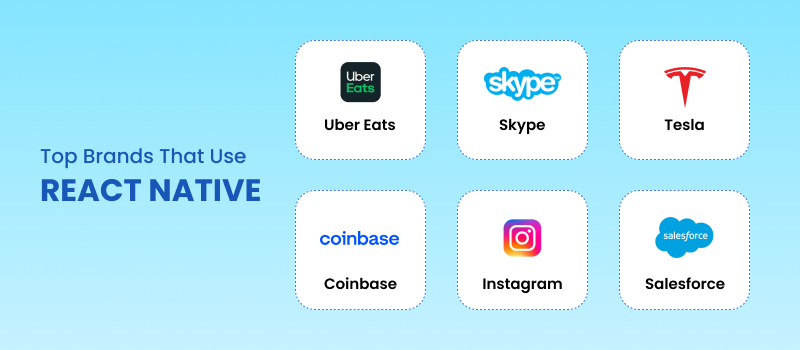
- Uber Eats
- Skype
- Tesla
- Coinbase
- Salesforce
In the 2023 edition of the Stack Overflow Survey, Flutter still tops React Native, according to developers (all responders).
How to Choose a React Native Development Company?
There are a few things that you should check while selecting a React Native app development company, and make sure to take care of these points while selecting.
Experience and Expertise: Seek out a company with a proven track record of delivering successful React Native projects. Their portfolio and client testimonials should speak volumes about their expertise.
Team Composition: A top-notch React Native development company should boast a team of highly skilled developers, designers, and project managers. This diverse talent pool ensures that your project is in capable hands.
Communication and Collaboration: Effective communication is paramount. Look for a company that is responsive, transparent, and open to collaboration. This ensures that your vision is understood and executed flawlessly.
Quality Assurance: A robust quality assurance process is essential to ensure the final product meets your expectations. The company should rigorously test the app on various devices and platforms to ensure compatibility and performance.
Cost and Budget: While cost is a factor, prioritize quality over price. Make sure to consider a company that offers competitive rates without compromising on quality.
Support and Maintenance: Ongoing support and maintenance are crucial for the long-term success of your app. Choose a company that offers the best React native mobile app development services to keep your app up-to-date and functional.
Client References: Speaking to past clients can provide valuable insights into the company’s work ethic and professionalism. Don’t hesitate to ask for references and testimonials.
Scalability: A company’s ability to scale up or down based on your project’s needs is essential. They should be able to accommodate changes in scope or requirements without compromising on quality or timelines.
Are You Looking to Develop Your App Using React?
If you’re looking to develop a React Native app, you’ve come to the right place. We are a leading React Native App Development company specializing in React Native mobile app development and have deep expertise in building high-quality, cross-platform mobile applications.
Our team of experienced React native developers, designers, and project managers is well-versed in the latest technologies and best practices, ensuring that your app is not only visually stunning but also performs flawlessly across different devices and platforms.
We understand that every project is unique, which is why we take a collaborative approach to ensure that your vision is brought to life exactly as you imagined it.
Build a React Native app with us and get the best in the market. Our 36+ years of experience are proof that we always fulfill our client expectations to the best.
From concept to launch, we’ll work closely with you to ensure that your app meets your expectations and delivers a seamless user experience.
Get in touch with us today to discuss your project, and let’s turn your ideas into reality!
Frequently Asked Questions
The to develop React Native app can vary widely, but on average, it can cost anywhere from $10,000 to $500,000. The cost depends on factors such as complexity, features, platforms, and location.
React is a popular JavaScript library for building user interfaces for web applications, while React Native is a framework for building mobile applications using JavaScript and React. If you want to build a web application, react is a good choice. If you want to build a mobile application, React Native is a good choice.
Some future trends of React Native include:

SPEC INDIA is your trusted partner for AI-driven software solutions, with proven expertise in digital transformation and innovative technology services. We deliver secure, reliable, and high-quality IT solutions to clients worldwide. As an ISO/IEC 27001:2022 certified company, we follow the highest standards for data security and quality. Our team applies proven project management methods, flexible engagement models, and modern infrastructure to deliver outstanding results. With skilled professionals and years of experience, we turn ideas into impactful solutions that drive business growth.
Table of contents
- So why is React Native so popular?
- What is React Native?
- How Does React Native Work?
- When to Use React Native
- React Native App Development Cost
- Example of App Built with React Native
- Benefits of React Native App Development
- React Native: Risk and Drawbacks
- Alternative of React Native
- React Native Vs Flutter
- How to Choose a React Native Development Company?
- Are You Looking to Develop Your App Using React App?
Delivering Digital Outcomes To Accelerate Growth
Let’s TalkTable of contents
- So why is React Native so popular?
- What is React Native?
- How Does React Native Work?
- When to Use React Native
- React Native App Development Cost
- Example of App Built with React Native
- Benefits of React Native App Development
- React Native: Risk and Drawbacks
- Alternative of React Native
- React Native Vs Flutter
- How to Choose a React Native Development Company?
- Are You Looking to Develop Your App Using React App?
Delivering Digital Outcomes To Accelerate Growth
Let’s Talk


Let’s get in touch!
India
SPEC House, Parth Complex, Near Swastik Cross Roads, Navarangpura, Ahmedabad 380009, INDIA.
-
 +91-79-26404031, 32-33-34
 -
 [email protected]